
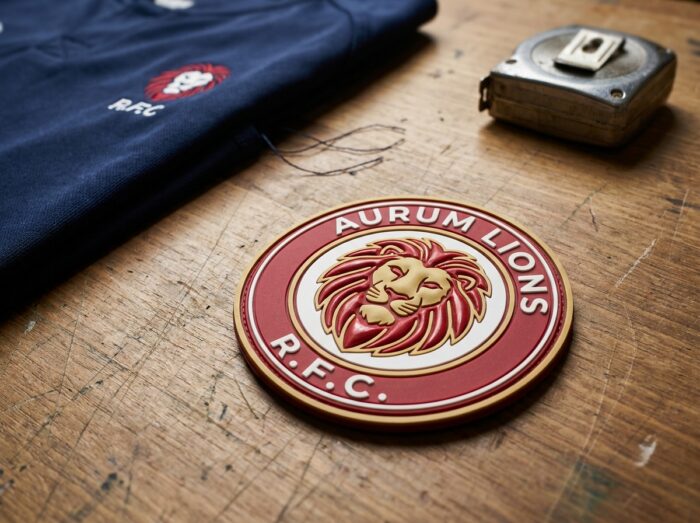
A jersey with a name on it is not enough to distinguish a departmental futsal team from a group of friends in a tournament. What establishes a visual identity at first glance is often a detail placed on the chest or sleeve: the club’s badge. Soft PVC has replaced embroidery on many professional outfits, and amateur clubs are starting to adopt it to enhance visibility without blowing their association budget.
Field constraints that guide the choice of PVC for an amateur club
The real context of use in an association locker room is rarely discussed. Jerseys go through high-temperature washes, sometimes dry on a radiator, and get rained on during a rugby match on a muddy field. A classic embroidered badge eventually frays after a few seasons.
Soft PVC is resistant to water, mud, and repeated friction. Its smooth surface does not retain dust or dirt, making it particularly suitable for outdoor sports. For an indoor handball or volleyball club, the advantage lies more in the clarity of the rendering: the colors remain vibrant even after numerous washes.
Before ordering, it saves time to precisely define the criteria for your custom PVC badge: shape, number of colors, type of attachment, and dimensions suitable for the intended fabric. A round logo of eight centimeters will not look the same on a fine technical jersey as it will on a thick training jacket.
Velcro or stitching: adapting the attachment method to the club’s operations
The question of the attachment method is often decided too quickly. Removable Velcro is appealing because it allows the badge to be removed before washing or transferred from one garment to another. In practice, Velcro is mainly suitable for clubs that share uniforms between different age categories or between the first team and the reserve.
Direct stitching remains the most reliable solution for a designated jersey worn every weekend. It prevents the patch from coming off during a match, which happens more often than one might think with poorly sized or worn Velcro.
Concrete case: sharing uniforms in a multisport club
Some sports associations group several sections (basketball, volleyball, badminton) under the same logo. Velcro allows the generic club badge to be placed on any section’s uniform. One order of PVC badges is made, and each section attaches the patch to its own jerseys as needed.
Feedback varies on this point: some equipment managers still prefer to sew on the badge to avoid losses during transport. The right compromise depends on the number of uniforms in rotation and the logistical rigor of the club.
Chemical compliance of PVC badges: what clubs need to check
Soft PVC contains plasticizers to remain flexible. The European REACH regulation strictly regulates several of these substances. Phthalates DEHP, DBP, BBP, and DIBP are limited to 0.1% by weight in certain categories of plasticized items. Requesting a material safety data sheet or a REACH declaration from the manufacturer protects the club in case of inspection or questions from a member’s parent.
Regulation (EU) 2024/2462 adds an additional constraint on PFAS in textile articles. This text specifically caps PFHxA and related substances in clothing and associated accessories. The measure applies to the homogeneous material concerned, not to an average calculated across the entire garment. A small attached badge can therefore become the critical point of a compliance analysis.
Documents to request from the supplier before confirming an order
- A REACH compliance declaration covering the plasticizers used in soft PVC, explicitly mentioning regulated phthalates.
- A certificate of absence of fluorinated treatments (PFAS) on the patch or its textile support, especially if the badge is thermally bonded to a water-repellent fabric.
- A physical sample to check the flexibility, color rendering, and compatibility with the jersey fabric before launching full production.

PVC badge and club image: strengthening identity without a sponsorship budget
For an amateur club that does not have a sponsorship contract or dedicated communication budget, the PVC badge plays the role of a physical logo. It visually unifies the entire team, from the youngest to the veterans, and provides a structured image during tournaments or official photos.
A raised badge with the club’s crest creates an immediate visual reference on the edge of the field. PVC allows for 2D or 3D rendering with sharp contours that traditional embroidery struggles to reproduce on complex logos with fine details or gradients.
Integrating the local sponsor’s logo on the badge
Some clubs add their main sponsor’s logo directly onto the badge, next to the crest. PVC allows for precise small-scale details, enabling the inclusion of a bakery or auto repair shop name without making the text unreadable. This approach values the partner while maintaining a professional appearance.
The unit cost of a PVC badge significantly decreases when ordered in bulk. For an association that outfits three or four teams, consolidating the order into a single batch reduces the price per piece and simplifies stock management.
Durability and end-of-life of PVC badges in an association setting
A well-made PVC badge generally lasts longer than the jersey it is attached to. When the outfit is retired, the patch can be cut off and sewn onto a new garment if Velcro or stitching allows it.
The question of end-of-life remains a blind spot for most suppliers. PVC is not biodegradable, and its recycling in conventional streams poses problems. For a club committed to an eco-responsible approach, extending the usage duration of each badge remains the most effective lever before considering alternatives like natural rubber or silicone.
Practically speaking, a well-sized batch of badges from the start avoids frequent restocks. Planning a few extra pieces for new members during the season limits individual orders, which are always more expensive and take longer to receive. The PVC badge is not just a decorative accessory: it is a tool for collective identity that, if well chosen, supports the club over several seasons without losing visual quality.