
A food dehydrator removes water from fruit to preserve it. A laboratory moisture analyzer measures the mass loss of a heated sample. A compressed air dryer removes moisture from an industrial pneumatic system. These three devices are sometimes called by the same name, but their principles, results, and uses have almost nothing in common.
Food drying, analytical drying, or industrial drying: three distinct goals
Before comparing technical specifications, the first question to ask is what material needs drying and what result you expect. Drying apple slices to preserve them for several months requires different temperatures, precision, and controls than determining the moisture content of a flour sample in a laboratory.
In food processing, the goal is to reduce a product’s water activity to inhibit microbial growth. The result is assessed by its texture, shelf life, and retention of nutritional properties.
In a laboratory, a moisture analyzer (or moisture balance) heats a sample and measures its mass loss. The result is a percentage, not food fit for consumption. Sample preparation can be just as important as the instrument itself: sampling, the container, and the time before analysis all directly affect the reliability of the measurement.
To choose a food dehydrator or moisture analyzer, first identify which of these fields your needs fall into, then define the measurable result you expect.

Food dehydrator: how it works and what to look for
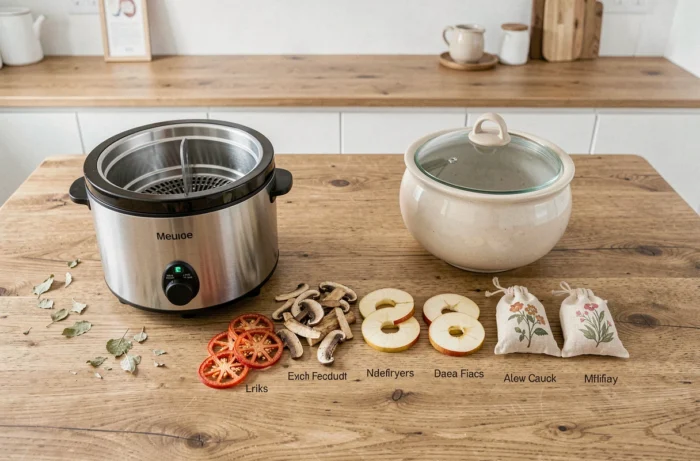
A food dehydrator works by circulating warm air at a low temperature, generally between 35 °C and 70 °C, depending on the model and food. A fan pushes air through stacked trays holding the products to be dried.
Drying takes several hours, and sometimes more than a day for dense fruit. This slow process is intentional: it removes water without cooking the product or destroying heat-sensitive compounds.
What really sets models apart
Capacity (the number and surface area of the trays), heating power, and, above all, consistent airflow are the key selection criteria. Uneven airflow means you have to swap the trays around during the cycle, making the process more complicated.
- Fan placement (at the back or base) affects airflow distribution: a rear-mounted fan generally provides more even drying across all the trays.
- An adjustable thermostat lets you tailor the temperature to the product: herbs, meat, fruit, and vegetables all require different drying conditions.
- Cooling the food before packaging and storing it away from moisture are important steps. Even a well-dried product will spoil quickly if it is packaged improperly.
Choosing an appliance does not replace proper preparation and storage practices. Even slicing, pretreatment (blanching or acidifying), and airtight packaging all contribute as much to the final result as the machine itself.
Laboratory moisture analyzer: measuring moisture, not simply drying
In analytical settings, the term “desiccator” most often refers to a thermogravimetric moisture analyzer. The instrument heats a weighed sample and continuously records its mass loss until it stabilizes. The result is expressed as a percentage of moisture.
Halogen-heated models are widely used because they are fast. One technical point deserves attention: this type of instrument does not necessarily measure water content in the strict sense. It quantifies the total mass lost during the heating program, which may include other volatile compounds. If the goal is to measure water specifically, the method must be checked for the material being analyzed.
Sample preparation: the often-overlooked factor
A sample can gain or lose moisture between collection and measurement. The container, storage time before analysis, and grinding or cutting method can all affect the result. Two measurements from the same batch can differ if the preparation is not the same.
This level of rigor has no equivalent in home food drying, where variation between batches is acceptable. The two devices share the word “drying,” but the quality standards surrounding them are radically different.
Compressed air dryer: a third use not to be confused with the others
In industry, the term “desiccator” or “desiccant dryer” refers to equipment that removes moisture from compressed air. Its purpose is to protect pneumatic systems, tools, and downstream products from corrosion and contamination.
Two technologies are used:
- A refrigerated dryer cools compressed air to condense the water, which is then drained away. It is suitable for applications where a moderate dew point is sufficient.
- A desiccant dryer passes air through an adsorbent material (silica gel or activated alumina) that can achieve very low dew points, as required, for example, in food processing or pharmaceuticals.
- The choice between the two depends on the dew point required for the application, energy consumption, and maintenance costs, including replacement of the adsorbent material or the purge air needed for regeneration.
A beverage manufacturer that uses compressed air in its packaging process does not have the same requirements as a paint shop. Operating pressure, flow rate, and ambient temperature determine the dryer’s size.
Which measurable result for which drying appliance?
The real selection criterion is not the appliance’s technology, but the result you expect. A food dehydrator is judged by the texture and shelf life of the finished product. A moisture analyzer is judged by the repeatability and accuracy of its measurements. A compressed air dryer is judged by the dew point achieved at the outlet.
Confusing these three fields leads to meaningless comparisons. A laboratory moisture analyzer does not “dehydrate” better than a food dehydrator: it simply does a different job. Before looking at technical specifications, clearly identifying what you want to dry and the quantifiable result you need is the most reliable way to guide your purchase.