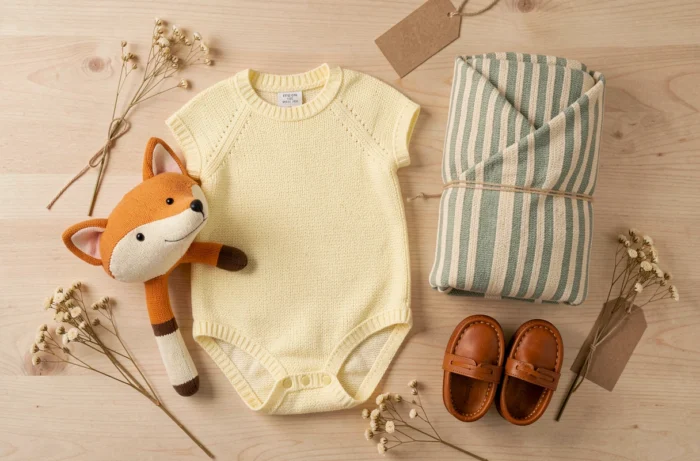
Between sizes that change every two months and accessories used for just a few weeks, a baby’s wardrobe raises a question rarely addressed by online shops: how to choose pieces that last, meet recent safety standards, and stand out as a birth gift? This article compares the concrete criteria that distinguish an original garment or accessory from a mere impulse purchase.
GPSR Regulation and Baby Accessories Safety: What Has Changed
Baby clothing and accessory catalogs rarely display their regulatory obligations. However, since December 13, 2024, the European GPSR regulation (General Product Safety Regulation) imposes new constraints on consumer products sold in the European Union.
For items intended for infants, this translates into enhanced traceability, documented risk analysis, and for sellers based outside the EU, the designation of a responsible economic operator within European territory. Safety information must accompany the product in a legible manner.
This regulatory framework directly affects bath accessories, bibs, pacifier clips, and diaper bags. Before succumbing to an original product on a marketplace, checking for compliance markings and an identifiable European contact remains the first useful precaution. Specialized shops that select European designers, like those found on https://www.lol-baby.be/, facilitate this sorting in advance.
Growth Clothing vs. Classic Sizes: Comparison Table
The French eco-organization Refashion recommends clothing that “grows with the child,” reversible or multifunctional models, and more durable materials. This positioning deserves to be compared with classic sizes to assess the real value of a birth gift.
| Criterion | Classic Size (1 month, 3 months, etc.) | Growth or Modular Clothing |
|---|---|---|
| Average Usage Duration | Several weeks to two months | Several months (progressive adjustment) |
| Purchase Cost | Generally lower per piece | Higher, but fewer pieces needed |
| Relevance as a Gift | Risk of duplication or size already exceeded | Usable even if given late |
| Common Materials | Standard cotton, polyester | More frequent use of OEKO-TEX or GOTS certified cotton |
| Resale or Second Hand | Rapid wear, low residual value | Better condition after use, easier resale |
The initial price gap is often offset by the reduced number of pieces to buy. For a birth gift, growth clothing avoids the pitfall of a size already exceeded on the day the parent opens the package.
Certified Materials: A Concrete Selection Criterion
OEKO-TEX and GOTS certifications guarantee the absence of harmful substances in contact with infants’ skin. On artisanal shops, these labels appear more systematically than on large generalist brands.
A GOTS certified organic cotton bodysuit contains neither formaldehyde nor azo dyes. For a baby who wears their clothes against their skin most of the day, textile certification remains the most reliable safety filter after regulatory marking.
Original Baby Accessories: Categories That Make a Difference
Search results for birth gifts often propose the same lists: bath cape, comforter, embroidered bib. Three less visible categories deserve attention for their originality/utilitarian ratio.
- Free motor skills accessories (structured play mats, support cushions) support development without constraining the baby’s movements, a criterion valued by early childhood professionals
- Multifunctional textile kits (swaddle that serves as a light blanket, sun protection, and emergency bib) reduce the volume of the diaper bag while being useful daily
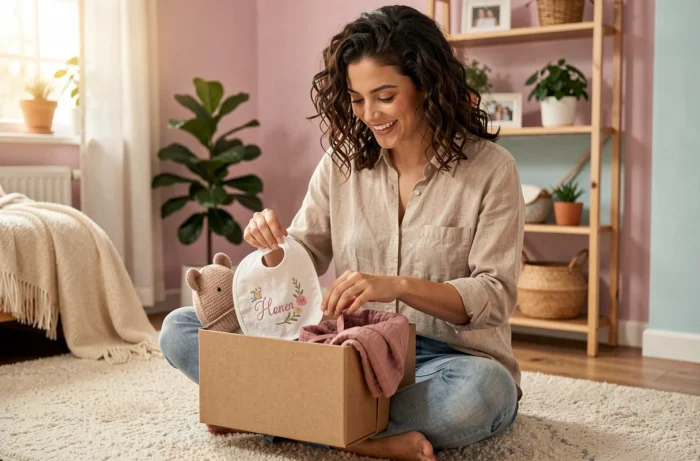
- Personalized clothing with name embroidery, which transforms a standard bodysuit or hat into a unique piece without compromising comfort or compliance with standards
An original accessory stands out for its versatility, not just its aesthetics. A product that is only used once ends up at the bottom of a drawer, regardless of its design.
Rental and Second Hand: A Growing Trend for Baby Clothes
Refashion identifies rental, second hand, exchange, and swapping as suitable solutions for clothes worn very briefly. Ceremony outfits for infants, costumes, and certain seasonal pieces (like a 6-month ski suit, for example) illustrate this need well.
The usage duration of baby clothing rarely exceeds a few weeks for the smallest sizes. Buying each piece new means creating a wardrobe where most items will be worn less than ten times.
Customization and Repair as Alternatives to Repurchase
Refashion also cites repair and customization among the means to extend usage duration. On growth clothing, replacing an elastic or adding a patch can gain an additional season.
This approach also changes the perceived value of a gift. Giving a carefully selected and customized second-hand garment (embroidery, patch, plant dye) has a more striking effect than a batch of new standard cotton bodysuits.
Selection Criteria for a Standout Birth Gift
Rather than a generic list, four filters allow for distinguishing options:
- Verifiable regulatory compliance (marking, European contact, textile certification)
- Actual usage duration, not the announced size but the weight or morphology range covered
- Versatility of daily use (a product that only serves for an Instagram photo is not a good gift)
- Relevance to the real needs of parents, who often prioritize practicality over decoration in the first months
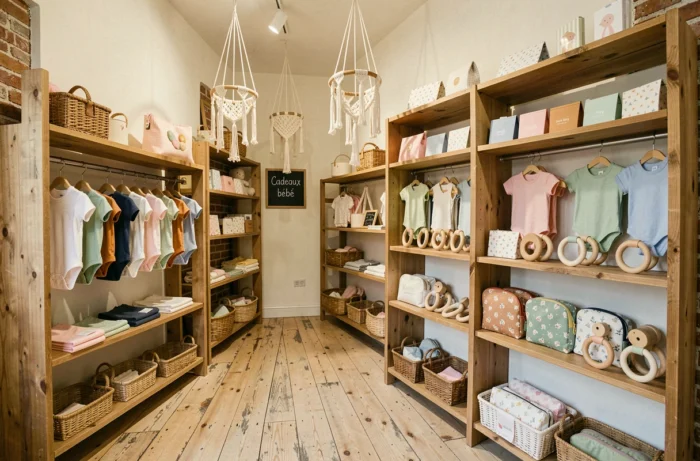
Specialized shops in original baby accessories and clothing facilitate this sorting by offering selections already filtered by material, certification, or broader age range.
The choice of a birth gift relies less on visual originality than on the product’s ability to remain useful beyond the first few weeks. A certified growth garment, a multifunctional accessory compliant with GPSR, or a well-chosen second-hand piece meet this criterion better than a standard gift set.