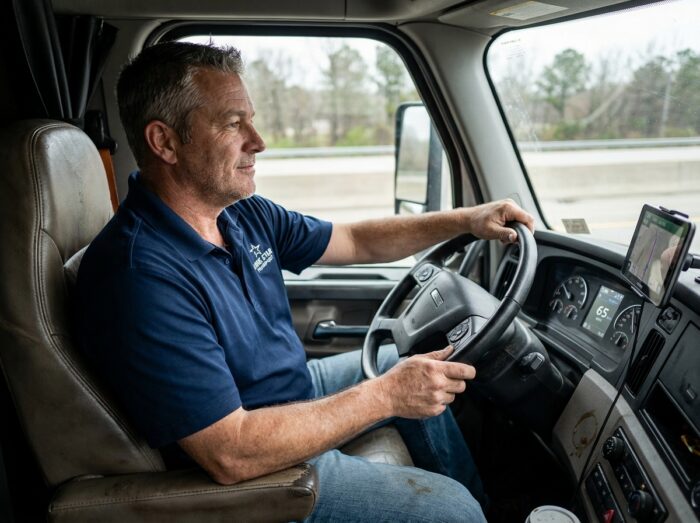
New heavy trucks registered in the European Union since July 7, 2024, are required to be equipped with an intelligent speed assistance system, known as ISA. This device alerts the driver when they exceed the current speed limit, through visual, auditory, or haptic signals. The driver can deactivate it, but the system automatically reactivates each time the vehicle is started.
The question is no longer whether speed will be monitored in trucks, but how to organize this monitoring so that it remains a working tool rather than a burden.
ISA mandatory on heavy trucks: what the system really does
ISA (Intelligent Speed Assistance) is part of the safety equipment mandated on new N2 and N3 heavy trucks in Europe, alongside drowsiness alerts and rear obstacle detection. Its role is to compare the vehicle’s actual speed to the local speed limit, by cross-referencing GPS data and camera-based sign recognition.
The key technical point to remember: ISA informs but does not brake the truck on behalf of the driver. It is an “informative” or “warning” system. The driver retains full control of acceleration and braking. This distinction matters because it changes the perception of the device. A light signal on the dashboard does not detract from driving autonomy.
The automatic reactivation at each restart prevents prolonged driving without assistance. In practice, a driver who disables the system on a specific stretch (overtaking, merging) finds it active again as soon as they turn the ignition back on. This design avoids the scenario where the tool is permanently deactivated and forgotten. It also maintains the possibility of truck geolocation coupled with ISA to refine alerts based on the type of road.

Volvo Safety Zones: speed limits set by the carrier
Since June 2025, Volvo Trucks has introduced a feature called Safety Zones. The principle reverses the usual logic of speed control: it is not an external radar that penalizes, but the transport company that defines its own perimeters and the associated maximum speed.
The carrier maps out sensitive areas (village crossings, school surroundings, warehouse yards, construction sites) and sets a limit that can go down to 20 km/h. The engine then refuses to exceed this limit in the configured zone. If the truck enters too quickly, it can even brake automatically. Each vehicle can accommodate up to 300 active zones.
This approach changes the relational dynamics between the operator and the driver. The constraint no longer comes from a policing device but from internal company settings. The driver knows who set the rule, why (site protection, pedestrian safety), and can discuss it with their operations manager. The limitation becomes a topic of professional dialogue rather than an anonymous sanction.
Configuring zones without infantilizing the driver
The risk of such a system is to multiply restrictions to the point of turning every journey into a constrained route. The best practice is to limit Safety Zones to places where speeding creates a real danger:
- Warehouse maneuvering areas, where pedestrians and forklifts circulate in close proximity to the truck
- Urban crossings on regular routes, identified as accident-prone based on fleet feedback
- Surroundings of temporary construction sites, where signage may be poorly perceived from a heavy truck
Applying the same restriction on a clear highway or a smooth national road makes no sense. A targeted setting enhances the credibility of the system in the eyes of the driver and avoids the “permanent radar” effect.
Speeding in trucks: specific penalties under the highway code
Heavy trucks are subject to speed limits lower than those for light vehicles. In urban areas, the limit remains the same (50 km/h unless otherwise indicated), but outside urban areas and on highways, the thresholds differ. A speeding violation is therefore measured from these reduced thresholds, meaning a truck traveling at the same speed as a car can be in violation when the car is not.
Penalties follow the standard scale of the highway code: fines, penalties, and loss of points proportional to the observed excess. For an excess of less than 20 km/h outside urban areas, the fine is classified as third class. Beyond 50 km/h, the violation becomes a criminal offense with license suspension and court appearance.
The heavy truck driver also engages the employer’s responsibility if the vehicle is not equipped in accordance with regulations or if company instructions implicitly encourage exceeding limits (unrealistic delivery deadlines, for example). This dual responsibility explains why carriers have an interest in documenting their speed policies rather than relying solely on the individual driver’s behavior.
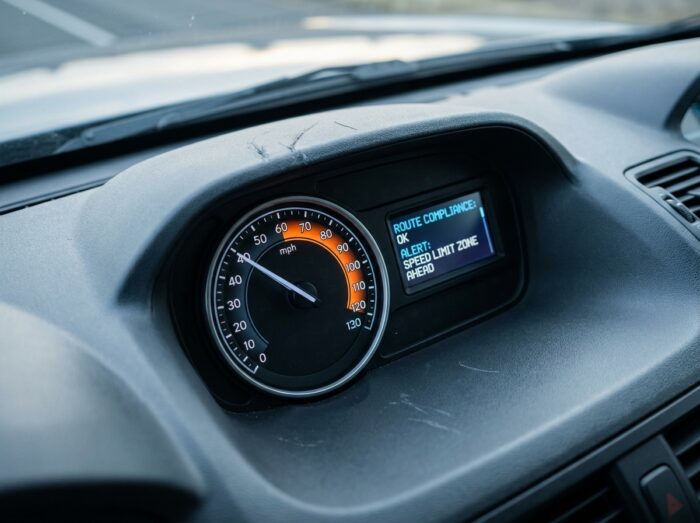
Building a speed policy without permanent surveillance effects
Embedded technology (ISA, Safety Zones, telematics) only produces a lasting result if the driver understands its purpose. Three conditions help avoid the feeling of being monitored:
- Transparency about the data collected: the driver must know what information is sent to the fleet manager (instant speed, triggered alerts, location) and how often
- Using data for coaching, not for systematic punishment: a monthly report identifying risky stretches and suggesting driving adjustments has more impact than calling in drivers for each alert
- Involving the driver in the settings: asking drivers to report areas they consider dangerous enriches the Safety Zones mapping with their on-the-ground expertise
A speed limitation system perceived as a professional protection tool reduces resistance to change. The issue is not technical; it is managerial.
Companies that share the results of their speed policy (reduction in accidents, decreased wear on brakes and tires, stability of delivery times) provide drivers with a concrete reason to adhere to the system. The technical constraint exists. How it is presented and used determines whether it becomes a safety lever or a source of distrust.