
Every week, a few hours become available. The most common reflex is to look for a list of activities, to spot three or four appealing ones, and then to practice none beyond the second attempt. The problem does not stem from a lack of leisure ideas, but from a gap between what looks enticing on paper and what is sustainable, considering your budget, available energy, and place of residence.
Choosing a hobby compatible with your daily life: budget, energy, and proximity
You may have already noticed that an activity abandoned after three weeks often shares the same flaw? It required too long a commute, expensive equipment, or a time slot incompatible with the rest of the week.
Before browsing through catalogs of ideas, apply three concrete filters. The first is financial: some activities (indoor climbing, pottery classes, cooking workshops) involve a subscription or regular material costs. Others, like walking, reading, or drawing, cost almost nothing.
The second filter concerns the proximity of the practice location. Surveys on the sports habits of Parisians confirm a logical point: regular practitioners choose a location close to home. This observation holds true for all hobbies. A ceramics workshop forty minutes away by public transport will be abandoned long before a sketchbook placed on the living room table.
The third filter is energy. After a day of physical work, an intensive sports class can feel like a chore. Conversely, a sedentary person all day will find more benefit in an activity that gets them moving. You will also find on the 11 Le Magazine website sections that categorize hobbies by practice context, which helps to sort quickly.

Creative hobbies at home: accessible activities without heavy equipment
The home remains the most underestimated playground. No commute, no time constraints, no registration fees. The usual barrier can be summed up in one sentence: “I am not creative.” This is rarely true.
Drawing, writing, and cooking are three creative hobbies that only require basic supplies. A pencil and a notebook are enough for drawing. A free word processor suffices for writing. Cooking, on the other hand, transforms a daily obligation into a testing ground, provided you try a new recipe rather than repeat the same dishes.
Board games and video games with family
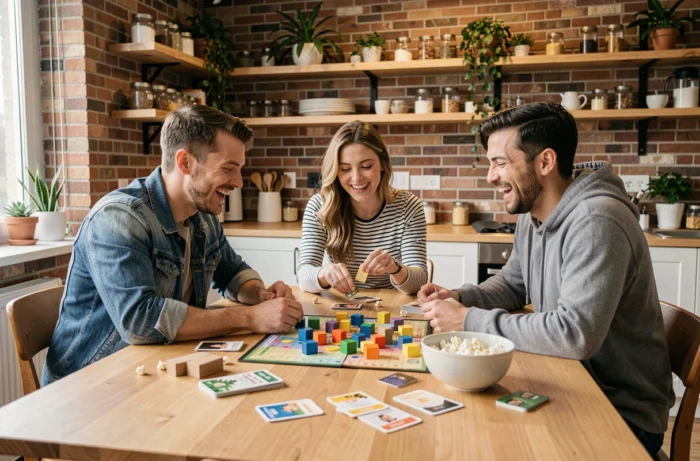
Board games have an advantage that screens do not always offer: they require direct interaction. For a family with children, a cooperative game creates a shared moment without frustrating competition. Video games, on the other hand, are better suited for teenagers or adults looking for a solo hobby or online activity with friends.
The choice between the two mainly depends on what you are looking for: a collective hobby around a table or an immersive individual activity.
Outdoor activities: walking, gardening, and local volunteering
Walking and hiking are among the outdoor hobbies that have been on the rise in recent years. Their main advantage: no club membership, no specialized equipment needed to start, and practice possible almost anywhere, including in urban areas.
- Daily walking (30 to 45 minutes) serves as a decompressing buffer after work, with no cost or preparation.
- Gardening, even on a balcony, combines gentle physical activity with visible concrete results in a few weeks.
- Occasional volunteering with a local association offers a social framework without the rigid commitment of a club. Flexible formats, for half a day or a weekend, facilitate participation for those hesitant to commit long-term.
These three activities share a common point: they require neither a significant budget nor particular physical condition. This explains their regularity among those who adopt them.
Outdoor classes and workshops: sports, photography, urban sketching
For those who prefer a structured setting, outdoor classes (yoga in a park, urban photography workshop, sketching session) combine the benefits of being outside with guided learning. Costs vary, but are often lower than those of a private studio.
Why choose this over an indoor class? The environment changes with each session, which reduces monotony, the primary factor for dropping out.
Accessible cultural hobbies: reading, music, and visits
Reading remains the cheapest and most flexible hobby. A municipal library provides access to thousands of titles without spending a dime. E-readers allow you to carry an entire library on the go.
Listening to music is the most widespread leisure activity in France. Streaming platforms have made access nearly unlimited, but attending a local concert, even a small one, offers an experience that listening through headphones cannot replace.
Museums and temporary exhibitions provide a one-time leisure activity that requires no regular commitment. For someone hesitant to sign up for something, a free visit remains an entry point without constraints.
Learning a new skill: a lasting hobby
A hobby that involves gradual learning is more likely to last than a purely recreational activity. The reason is simple: each session produces measurable progress, which maintains motivation.
- Learning a musical instrument (even self-taught with free tutorials) structures free time over several months.
- Taking an online foreign language course turns a daily 20-minute slot into a real skill.
- Getting started with sewing, woodworking, or object repair produces concrete results and reduces household expenses.
A hobby that teaches you something is more resilient to abandonment than a purely distracting hobby. The feeling of progressing compensates for the days when motivation wanes.
Finding the right hobby does not involve a list of fifty suggestions. Three criteria are enough: the actual time you have, the money you can spend without stress, and the distance between your home and the practice location. A modest but regular activity brings more than an ambitious project attempted twice and then forgotten in a drawer.