
A raw denim, a white t-shirt, white sneakers. The outfit is clean, but it says nothing. Add a bracelet to the wrist and the gaze stops. This little accessory acts as a focal point that directs attention and gives direction to the whole look. Understanding why, and especially how, allows you to transform any neutral base into a bold outfit.
Why the bracelet structures style better than an additional garment
Have you ever noticed that adding a jacket or scarf to a simple outfit can sometimes overwhelm it? The bracelet works differently. It does not compete with the main pieces.
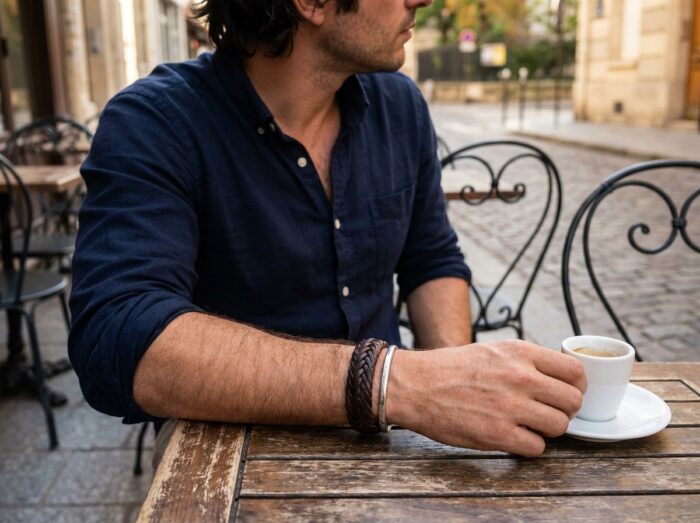
Its role is that of a discreet focal point that directs the gaze. On a monochrome or minimalist outfit, the wrist becomes the area where the eye naturally rests, especially when the sleeves are rolled up or short.
This mechanism relies on a simple principle: a neutral base leaves room for a single distinctive element. A silver steel bracelet on a navy sweater, a gold bangle on a white shirt, a braided cord on a gray t-shirt. Each combination creates enough contrast for one to perceive a stylistic intention without apparent effort. This is what makes the cord bracelet as the finishing touch of an outfit so effective on a daily basis.
The difference with a necklace or earrings lies in contextual visibility. The wrist moves, accompanies gestures, and appears in the interlocutor’s field of vision with every hand movement. The bracelet is the most exposed accessory in real situations, whether in a meeting, at the table, or while walking.
Adapting the bracelet to the wrist’s morphology
This is an angle that most fashion advice ignores. We talk about color, material, style, but rarely about wrist size. Yet, this is what makes the difference between a bracelet that fits and one that floats or compresses.
Narrow wrist: favor discreet models
On a thin wrist, a wide cuff bracelet will crush the hand and unbalance the silhouette. Thinner models work better: delicate chain, simple cord, narrow bangle.
A thin bracelet on a thin wrist creates a clean line. The accessory extends the arm instead of visually cutting it off.
Wide wrist: dare the volume
Conversely, a too-discreet bracelet on a wide wrist goes unnoticed. This is where a metal cuff, a thick leather bracelet, or an accumulation of beads makes perfect sense.
The idea is not to cover the wrist, but to create a coherent proportion relationship between the accessory and the arm. A beautifully wide black leather bracelet on a solid wrist gives a visual anchor to the entire outfit.
Choosing the bracelet material according to the context
The same bracelet does not work everywhere. The material sends an immediate signal about the outfit’s register. Here are the associations that work without having to think:
- Steel or silver metal: urban and professional register, worn with a shirt, blazer, or matching watch
- Black or brown leather: casual register, ideal with jeans, chinos, or a canvas jacket
- Natural beads or stone: relaxation or bohemian register, works with linen, raw cotton, earthy colors
- Braided cord or fabric: everyday and casual register, goes anywhere without ever overwhelming
A common trap is wearing a beaded bracelet with a suit or a steel bangle with beach shorts. The mismatch may be intentional, but it must remain readable as a choice, not as a mistake.

Single bracelet or accumulation: where to place the cursor
Stacking bracelets is everywhere on social media. Three, four, five pieces on the same wrist. In practice, this approach requires real mastery to avoid tipping into overload.
The most reliable rule: one visual axis per wrist. If you stack, stay within the same family of materials. Two metal bracelets of different widths, or a cord paired with a thin bangle, create a coherent set.
Mixing leather, beads, and metal on the same wrist often produces a thrift shop effect. Each material pulls the eye in a different direction, and the outfit loses readability.
For most situations, a well-chosen single bracelet has more impact than a haphazard accumulation. Minimalism is not shyness: it is a clear intention.
Bracelet and watch: how to make them coexist
Wearing a bracelet on the same wrist as your watch works under one condition: that the two pieces do not compete for attention. A thin metal bracelet in the same tone as the watch case creates continuity. A thick leather bracelet next to a dress watch creates a visual conflict.
The other option is to wear the bracelet on the opposite wrist. This distribution balances the silhouette and gives symmetry to both sides of the body.
The bracelet does not magically transform an outfit. It does so because it concentrates attention on a specific point, suited to the body and the context. A single well-calibrated bracelet, worn with intention, is enough to elevate an outfit from “correct” to “thoughtful”.