
A thermal auger motor transforms a manual drilling process that takes several hours into an operation of just a few minutes. The principle is based on a two-stroke gasoline engine that drives a helical bit via a reducer. The torque transmitted to the handles can be violent in case of an obstacle, making the mastery of the gesture and the preparation of the site as crucial as the choice of the machine.
Torque and Jamming: Understanding the Mechanics Before Drilling
The power displayed by an auger motor tells only part of the story. What matters at the moment of drilling is the available low-speed torque. When a bit encounters a thick root or a stone, the resistance is transmitted directly to the handles in the form of a twisting jolt.
On a machine without a torsion damper, this transfer can wrench the auger from the operator’s hands or twist their wrists. Therefore, the risk of jamming is primarily a torque risk, not just a power risk.
Before starting a job, check that your machine has a damping device. If you are using a model without this system, adopt a wide and firm grip, with slightly bent arms, to absorb shocks. To know the technical specifications of your device, consult the user manual for auger motor provided with your model.
Locating Underground Networks Before Drilling
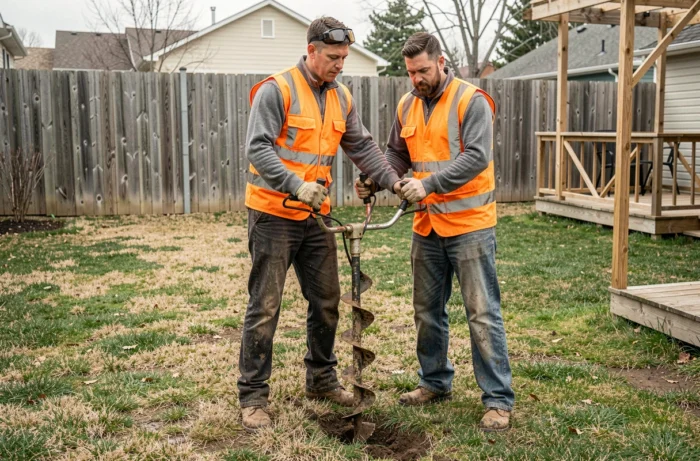
Too many guides jump straight to the digging technique. Locating underground networks should be treated as the first real step of the job, even before taking the auger out of the vehicle.
Electrical cables, gas lines, buried irrigation pipes: a bit launched at full speed that hits a live wire creates an immediate danger. For private land, the plans for the installation of supply networks and automatic irrigation layouts form the basis for locating.
In a professional context, a work declaration (DT/DICT) is required to identify the networks of utility companies. This administrative process takes a few days, so it must be anticipated.
Mark the areas to avoid on the ground with marking paint or stakes. If there is any doubt about the presence of a network, shift the hole or probe manually the first few centimeters before engaging the powered bit.
Short Sequence Drilling Technique
The common reflex is to push the bit continuously until the desired depth is reached. This approach causes three simultaneous problems: the soil compacted around the helix increases resistance, the engine heats up, and the operator tires without realizing it.
Drilling in passes of a few tens of centimeters and then pulling the bit up to remove the spoil reduces each of these risks. The helix turns empty when coming up, which expels the accumulated soil and gives the engine time to recover thermally.
Adapting the Gesture to the Type of Soil
In loose or sandy soil, the passes can be longer because the resistance remains low. In clayey or stony soil, shorten the passes and increase the frequency of ascent.
- Loose soil: regular passes, moderate rotation speed, little risk of jamming.
- Clayey soil: short passes, frequent ascent to detach the soil stuck to the helix, cleaning the bit between holes.
- Stony soil: cautious advancement, immediate stop at the slightest blockage to avoid a torque backlash in the handles.
Keep the auger perfectly vertical throughout the operation. Even a slight angle creates a lateral force that wears the bit unevenly and produces an oval hole, unusable for a post or fence stake.
Vibrations and Fatigue: Managing Long Sessions
The vibrations from a two-stroke engine transmitted through the handles are not just a simple discomfort. During a prolonged session (several dozen holes, for example for a complete fence), fatigue in the hands and forearms accumulates and reduces the ability to react in case of blockage.
Alternate operators if the job allows. Plan regular breaks, not for the engine which can keep running, but for your joints. Thick anti-vibration gloves limit transmission, provided they do not reduce grip quality.
Protective Equipment to Wear Systematically
- Reinforced protective gloves (anti-vibration if possible) to absorb shocks and protect from projections.
- Safety glasses or face shield: the bit projects stones and soil at high speed.
- Hearing protection: a two-stroke engine exceeds the sound comfort threshold, and cumulative exposure over a workday damages hearing.
- Non-slip sole shoes with reinforced toes: the auger is heavy and freshly drilled ground can be unstable.
Bit and Fuel: Maintenance Between Uses
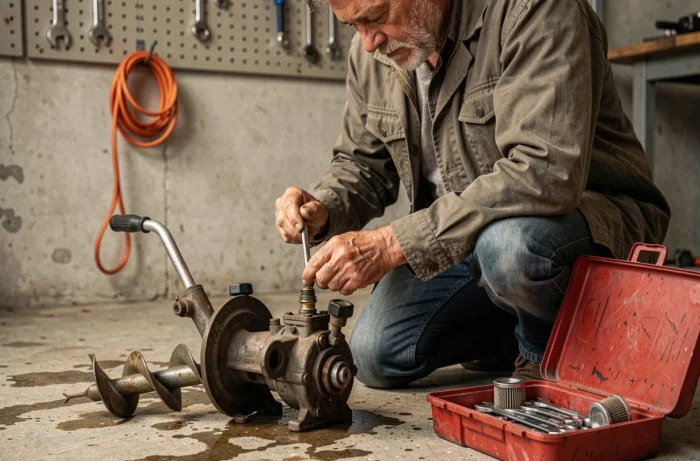
After each session, clean the bit to remove compacted soil, especially if the ground is clayey. Dry clay forms a hard crust that destabilizes the helix at the next start and accelerates wear on the reducer.
On the engine side, the oil-gas mixture must strictly adhere to the ratio indicated by the manufacturer. An excess of oil fouls the spark plug and the exhaust. A lack of oil causes premature wear of the piston. Prepare the mixture in a dedicated graduated can, never directly in the tank.
Regularly check the condition of the air filter, spark plug, and starter cord. On an auger motor, these wear parts undergo significant stress due to drilling dust and constant vibrations.
Neglecting maintenance does not manifest as a sudden breakdown, but as a gradual loss of power that leads the operator to force, increasing the risk of jamming and fatigue. Treating each end of a job as a mini-technical inspection remains the best way to keep the machine reliable season after season.