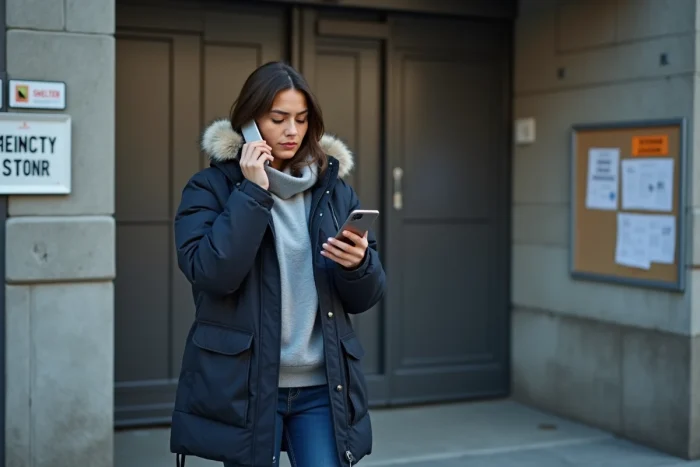
In France, access to emergency accommodation depends on a unique number, 115, available 24/7 and managed by the Samu social. Despite this centralization, some local or associative initiatives can step in when places are lacking or when the situation demands it.
Direct contact with the district town hall or the department’s social services often represents an underutilized alternative, especially in large urban areas like Paris, where the saturation of official systems is frequent. Coordination between public institutions and associative networks plays a crucial role in expediting assistance.
In the face of an emergency, how to react to avoid being left without a solution in Paris?
In Paris, social emergencies require immediate action. Call 115, the free line available at any time, orchestrated by the Samu social. This service directs you to an emergency accommodation center (CHU), ensuring immediate shelter, dignified reception, and sometimes support towards more stable prospects. Access does not depend on paperwork or background: anyone without a roof can request accommodation.
The capital, faced with constant pressure on its systems, prioritizes certain groups: people with disabilities, families with children, elderly individuals, pregnant women, victims of violence. If the response from 115 is delayed or if no places are available, turn to the CCAS of your district. Social teams assess the situation, propose other options, or help create a DALO file for the most vulnerable cases.
Students in difficulty can also contact the Crous for emergency accommodation, but places are often quickly filled. Young people who have just left child welfare, single individuals, those facing eviction or under threat of eviction, migrants, and asylum seekers also have specific support systems.
The question then arises: who to contact for emergency housing? For more information, the page “Who to contact in case of emergency for housing” gathers resources. In Paris, it’s best to act quickly and multiply efforts by mobilizing all institutional and associative networks. It is the responsiveness and coordination among actors that can turn a night outside into secure assistance.
Overview of immediately accessible emergency accommodation systems
To address immediate distress, emergency accommodation centers (CHU) are the first step in the process. They are open continuously, funded by the public, and welcome anyone in a vulnerable situation. Here are the profiles that can access them:
- families,
- isolated individuals,
- women victims of violence,
- young adults,
- migrants,
- people with disabilities.
A roof, facilities to wash, food, social support, and if necessary, initial medical or psychological follow-up: reception does not require paperwork or prior conditions. Depending on needs, further orientation continues towards more suitable solutions.
When CHUs are full, social reintegration centers (CHRS) sometimes take over. Here, the support aims to be more sustainable: assistance towards autonomy, access to rights, and search for a stable solution. Another option is that a hotel night can be mobilized, especially for families with children or the most vulnerable individuals.
Students in emergency situations can request temporary housing from the Crous. For young employees, youth worker hostels (FJT) and temporary residences offered by Action Logement provide alternatives.
Associative structures like Emmaüs, Secours Populaire, the Red Cross, or the Abbé Pierre Foundation also intervene to provide shelter, support, or guidance. The FSL (housing solidarity fund) can financially support access to or maintenance in housing, while the Garantie Visale secures pathways without a guarantor. Multiply requests, as each actor can open a different door in an emergency.

Who to call first and how to get help quickly?
115 remains the first point of contact. This number, operational at all times, offers immediate listening and guidance towards suitable accommodation based on the situation described. This reflex is essential, especially in Paris, when one finds themselves without housing solutions, isolated, or facing homelessness. Families with children, people with disabilities, pregnant women, victims of violence, or elderly individuals receive priority treatment.
If no response is found through this channel, the CCAS of your local town hall can propose other options. This service supports and fights against all forms of exclusion, sometimes in connection with the SIAO, the integrated reception and orientation service, which manages access to emergency systems or longer-term solutions.
For the most critical situations, the prefecture can initiate the DALO (right to housing) procedure, paving the way for the urgent allocation of social housing, depending on urgency and vulnerability.
Do not remain alone in the face of distress: social workers present in town halls, hospitals, or associations know the ins and outs and facilitate procedures. Their support accelerates access to a solution, secures the journey, and breaks isolation in the most precarious situations.
The first call, the first step, can change everything: a voice on the other end of the line, a door opening, a night finally sheltered. Sometimes it only takes a few minutes to shift from doubt to security.