
The television in a cruise cabin no longer functions like a traditional set connected to a terrestrial antenna. The signal is transmitted via satellite, with bandwidth constraints dictating everything else: the number of available channels, image quality, and stream stability. Understanding this technical mechanism changes the way to evaluate what is included in the ticket price and what is considered an extra charge.
Satellite Signal and Bandwidth: The Real Limiting Factor for Channels on a Cruise
A ship at sea captures its television streams via stabilized satellite dishes, constantly pointed at geostationary satellites. Coverage depends on the navigation area: in the Mediterranean or the Caribbean, the satellite beam remains adequate. On transatlantic routes or approaching polar regions, satellite reception significantly deteriorates, with intermittent outages reported by passengers on long crossings.
The total bandwidth of the ship is shared among linear television, passenger Wi-Fi, crew Wi-Fi, and onboard operational systems. When the company allocates more bandwidth to Wi-Fi (which is more profitable), it compresses the number of channels broadcast in cabins. This is a technical as well as an economic trade-off.
Since the post-Covid recovery, we have observed a gradual shift: several companies have reduced the number of linear channels in cabins in favor of streaming applications integrated into the televisions. The issue is no longer “paying for TV or not,” but paying for sufficient internet bandwidth to stream or not. Netflix, YouTube, or in-house platforms require a Wi-Fi package, which is almost always paid.
This evolution allows enjoying the channels on board only if the passenger has subscribed to the right level of internet package, which blurs the line between “free TV” and “paid TV.”
Free Channels and Premium Packages: What Each Level Actually Includes
The distinction between free and paid varies by company, but the general pattern repeats. The so-called free channels are limited to a restricted bouquet: continuous news (often in English), one or two internal ship channels (activity program, bow camera), and sometimes a few movies on loop.
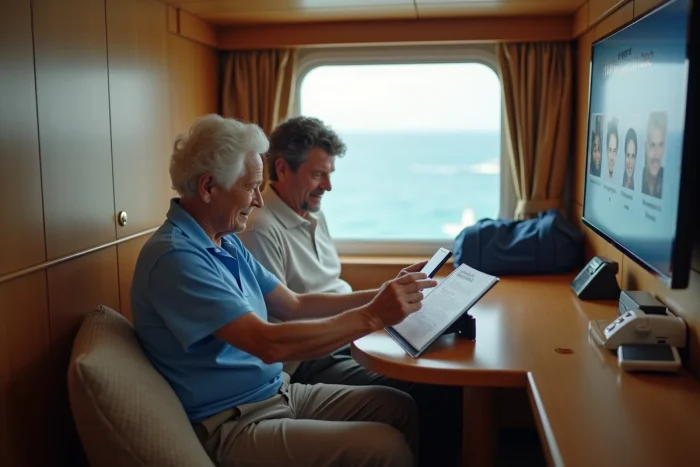
Premium packages include live sports, recent cinema, and VOD. These premium channels are increasingly integrated into combined Wi-Fi + TV packages, making it difficult to purchase just television without subscribing to the whole package. Here are the usual components of these bundled offers:
- A standard or high-speed Wi-Fi access, necessary for onboard streaming and sometimes to unlock certain channels on the cabin television
- A catalog of videos on demand accessible from the cabin screen or a dedicated tablet app
- Live sports channels, charged as an extra or included in high-end “all-inclusive” packages
The cabin category also plays a role. On some companies, suites and higher-category cabins automatically include the premium package. In standard cabins, the basic bouquet remains the only free access.
Differences Between Companies: MSC, Costa, and the Premium Segment
At MSC, the cabin television offers a limited number of free satellite channels. Access to Wi-Fi, essential for using onboard streaming functions, comes with separate packages. The Costa Diadema ship, tested by specialized journalists, operates similarly: a few basic channels in the cabin, the rest behind a package.
In the premium and luxury segment, the logic sometimes reverses. Companies like Cunard or Silversea tend to integrate more services into the initial fare, including more generous Wi-Fi access. We recommend systematically checking the conditions of the announced “all-inclusive” package: an “all-inclusive” does not always cover high-speed Wi-Fi or live sports channels.
World cruise itineraries pose a specific problem. On multi-month routes, passengers traverse different satellite coverage areas. The bouquet of available channels may change during the journey, with some European channels disappearing once the ship is out of the coverage area of the relevant satellite.
Optimizing TV Access in Cabins Without Overpaying
Before boarding, three checks can help avoid unpleasant surprises:
- Consult the detailed ship sheet on the company’s website to identify the type of television in the cabin (standard screen or smart TV with integrated apps) and the included basic bouquet
- Compare the cost of the Wi-Fi package alone with that of the combined Wi-Fi + premium TV package, as the difference is sometimes marginal and the package may prove more advantageous
- Download content locally (series episodes, movies) on a tablet or laptop before departure, which eliminates dependence on satellite bandwidth

Pre-downloading remains the most reliable solution. No Wi-Fi package guarantees smooth streaming at all times, especially during peak hours when several thousand passengers are using the network simultaneously. Evenings at sea concentrate demand, and video quality suffers.
For live sports fans, the only realistic option remains the ship’s bar or common lounge, where the broadcast goes through the ship’s central system with dedicated bandwidth. Reception is more stable there than in individual cabins.
The choice to pay or not ultimately depends on the relationship between the cruise duration and the passenger’s habits. On a few-night itinerary in the Mediterranean, the basic bouquet is usually sufficient. On a transatlantic crossing or a world tour, the combined Wi-Fi + premium TV package becomes a budget item to anticipate from the moment of booking, just like excursions or specialty restaurants.