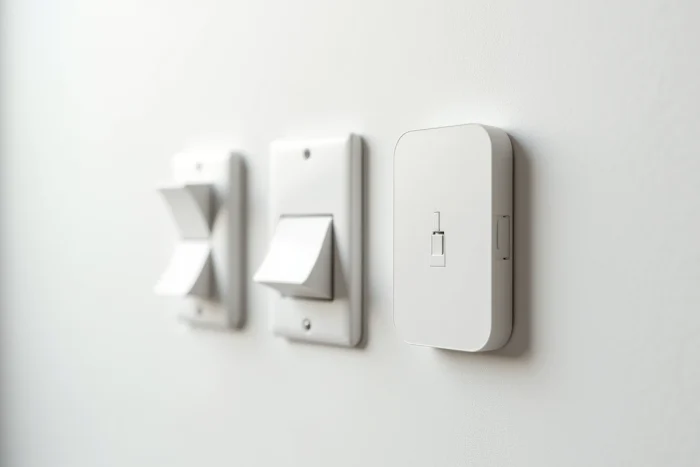
Three Legrand ranges coexist in the professional aisles and catalogs: Céliane, Mosaic, and Neptune. All bear the same brand, but they target different spaces and needs for customization. Comparing these Legrand switches requires looking beyond the simple displayed price, examining the modularity of the mechanisms, the plate system, and the available connected functions.
Modular mechanism vs. complete block: the true dividing line
The most significant difference between these ranges is not visible on the front. It plays out in the mounting box. Mosaic operates in 1 or 2 unit modules, designed to fit into conduits, technical columns, or multi-gang frames in 45×45 format. This modular system explains its dominance in the tertiary sector: offices, classrooms, public establishments.
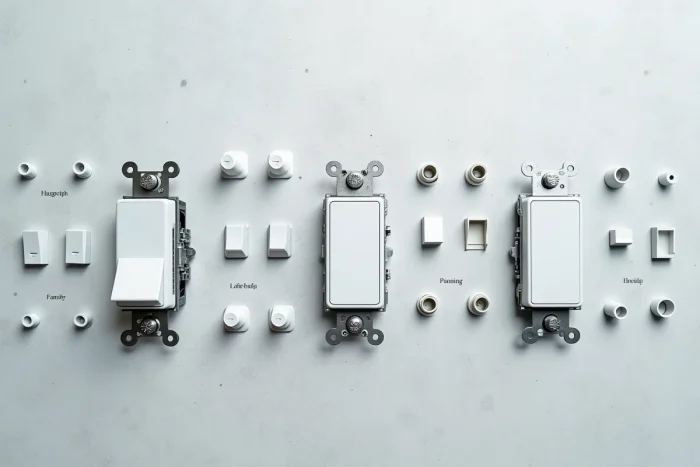
Céliane and Neptune adopt a different principle. The mechanism fits directly into a standard wall box and then receives a finishing plate. Installation is more intuitive for a homeowner or an electrician working in residential renovations. You will find a complete detail of the two-way switch installation for each range in Rêves de Déco’s advice, which illustrates the wiring step by step.
This modular architecture of Mosaic offers a much higher equipment density per post. Multiple functions (switch, RJ45 socket, USB socket) can be grouped in the same frame without multiplying the boxes. However, the catalog of decorative finishes is much more limited than in Céliane.

Comparison table Céliane, Mosaic, and Neptune
| Criterion | Céliane | Mosaic | Neptune |
|---|---|---|---|
| Main use | Residential habitat, decoration | Tertiary, collective, technical columns | Simple renovation, individual habitat (GSB) |
| Installation system | Mechanism + support + embedded plate | 45×45 modules or 2 modules, conduits and frames | Complete embedded block, simplified installation |
| Plate customization | Wide choice (materials, colors, finishes) | Functional plates, limited palette | Some standard colors |
| Connected functions | Dimmers, home automation scenarios, shutters | Tertiary functions (detectors, timers) | Basic functions (two-way, indicator) |
| Price positioning | The highest of the three | Intermediate (tertiary volume) | Entry-level |
Céliane offers the most extensive catalog of finishes at Legrand. Neptune positions itself at the opposite end, focusing on simplicity and contained pricing. Mosaic occupies a unique niche, dictated by compatibility with tertiary cable pathways.
Plates and finishes Céliane: what the higher price really funds
The additional cost of Céliane compared to Neptune is not just a brand issue. It funds a three-layer customization system: mechanism, fixing support, and then an independent decorative plate. This separation allows changing the appearance of a switch without touching the wiring.
Céliane plates come in glass, leather, wood, metal, and resin, with dozens of shades. This depth of catalog has no equivalent in Mosaic or Neptune, where the plates remain utilitarian.
The other consequence of this three-piece architecture: compatibility with advanced functions. Céliane accommodates rotary dimmers, roller shutter controls, and home automation interfaces without changing the plate. Neptune, repositioned since 2023 as the “essential design” range with a more contemporary look, remains confined to basic functions.
Home automation compatibility and dimmers
Céliane is the only one of the three ranges to natively integrate home automation scenarios controllable by centralized command. If a project includes lighting automation or shutter management, the choice effectively narrows to Céliane on the Legrand side.
Mosaic offers presence detectors and timers suitable for common areas, but no residential scenarios. Neptune has no connected functions in the current catalog.
Neptune after 2023: a repositioning to know before buying
Many comparisons still online describe Neptune as a basic and outdated range. Since 2023, Legrand has rethought this range under the name Neptune™, with a more sober and contemporary design, intended to gradually replace the old series in large DIY stores.
Neptune™ focuses on ease of installation and a low entry price. The block is delivered complete (mechanism + plate), which reduces the number of references to order. For a quick renovation where aesthetics is not a priority, this range fulfills its role without extra cost.
The limit appears as soon as one moves beyond the standard two-way switch:
- No dimmer integrated into the Neptune catalog, while Céliane offers several types (rotary, touch)
- No interchangeable plate: the color is chosen at purchase and cannot be changed later
- No roller shutter control or integrated USB socket in the range
Which Legrand switch according to the type of project
The choice between these three ranges depends less on personal taste than on the installation context. Here are the cases where each range naturally stands out:
- Mosaic for a professional space or a collective building with conduits and technical columns, where equipment density per post takes precedence over decoration
- Céliane for a residential habitat where the customization of finishes and home automation compatibility justify the higher budget
- Neptune™ for a standard residential renovation, without automation or specific decorative requirements, where the functionality/price ratio is the main criterion
The boundary between Céliane and Neptune hardens as soon as a project incorporates dimmers or motorized shutters. Neptune does not upgrade functionally, whereas Céliane easily accommodates additional controls on the same support. Mosaic, on the other hand, does not seek to compete on decorative grounds: its value lies in technical modularity and compatibility with tertiary wiring infrastructures.